

Hi friends,
When people hear the words thyroid nutrition, they usually think about iodine. And there is a good reason for that. Your thyroid gland literally uses iodine to make thyroid hormones. Without enough iodine, thyroid hormone production can become impaired.

But that is only one part of the story. Your thyroid does not take iodine and magically turn it into perfectly functioning thyroid hormones all by itself. It needs amino acids to build those hormones. It needs minerals that help enzymes work. It needs nutrients involved in converting thyroid hormones into their more active forms. Your blood has to transport those hormones, and your cells ultimately have to respond to them.
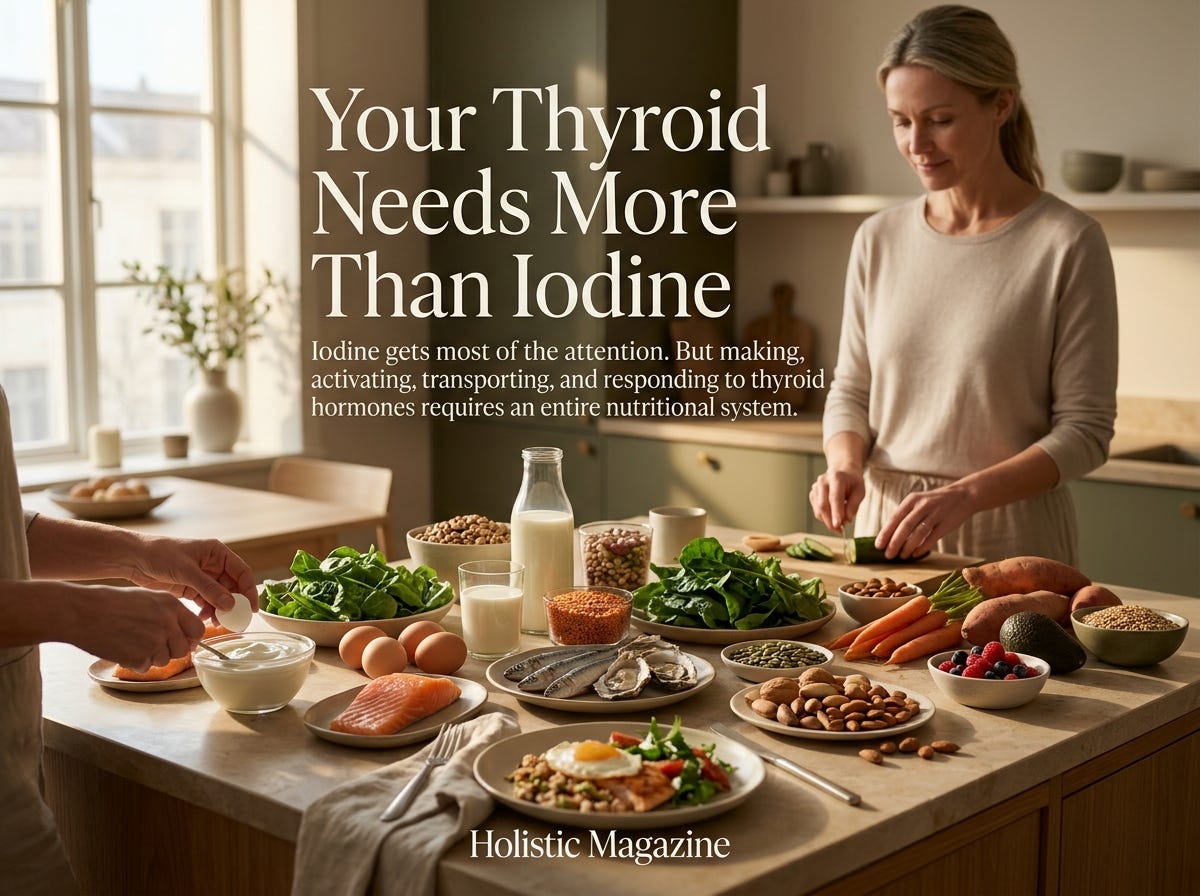
That means thyroid function depends on a much larger nutritional network than most people realize. Iodine matters enormously. But your thyroid needs more than iodine.
So today, let’s talk about the nutrients involved in thyroid hormone production, conversion, metabolism, and normal thyroid function, and why taking enormous amounts of any one of them is not necessarily better.
In Less Than 10 Minutes, We’ll Cover:
Why your thyroid needs more than iodine
How iodine and tyrosine work together to build thyroid hormones
Why selenium matters for thyroid hormone conversion
How iron supports thyroid hormone production
The role of zinc in hormone metabolism and cellular signaling
Why vitamins A and D matter for broader thyroid physiology
How magnesium and B vitamins support the metabolic environment around your thyroid
Why adequate protein matters for thyroid hormone production and metabolism
How your liver and other tissues help manage thyroid hormones
Why T4 needs to be converted into the more active T3
How your brain and pituitary regulate thyroid function
Why taking more iodine or other thyroid nutrients is not always better
How whole foods can provide multiple thyroid-supportive nutrients at once
When nutrient deficiencies can exist even with a healthy-looking diet
Why supplements can help in some situations but create problems when used indiscriminately
Before we begin, if you enjoy practical wellness breakdowns that connect nutrition, physiology, and everyday habits without the wellness fluff, consider subscribing to Holistic Magazine.
Free subscribers receive structured, science-backed wellness articles each week.
Paid subscribers receive deeper protocols, advanced nutrition guides, meal systems, and premium wellness breakdowns we usually cannot fit into regular posts.
Here’s what paid subscribers are reading right now:
We publish two premium articles per week.
First, What Does Your Thyroid Actually Do?

Your thyroid is a small butterfly-shaped gland located near the front of your neck. But the hormones it produces influence tissues throughout your body.
Thyroid hormones help regulate how quickly many of your cells perform metabolic processes. They influence body temperature, heart rate, digestion, energy expenditure, brain function, muscle function, growth, development, and the way your body uses carbohydrates, fats, and proteins.
Your thyroid primarily produces a hormone called thyroxine, or T4, along with smaller amounts of triiodothyronine, or T3. T4 is often thought of as a relatively inactive reservoir or precursor. Your tissues can convert some T4 into T3, which has stronger biological activity at thyroid hormone receptors.
That conversion happens in several parts of the body, including the liver, kidneys, and other tissues. So thyroid health is not simply about whether the thyroid gland itself can make hormones. Those hormones also have to be transported, converted, regulated, and recognized by cells throughout the body.
And nutrients participate at almost every step.
Iodine: The Raw Material for Thyroid Hormones

Iodine deserves its reputation as an essential thyroid nutrient. Your thyroid gland actively collects iodine from the bloodstream because iodine becomes part of the structure of thyroid hormones themselves.
The “T4” in thyroxine refers to four iodine atoms. T3 contains three. In other words, your body cannot make normal thyroid hormones without iodine.
Historically, iodine deficiency was a major cause of goiter, or enlargement of the thyroid gland, in many parts of the world. Iodized salt was introduced largely as a public health strategy to reduce iodine deficiency.
Today, iodine can come from iodized salt, seafood, dairy products, eggs, and certain sea vegetables. But iodine also illustrates one of the most important lessons in nutrition. More is not always better.
Very high iodine intake can disrupt thyroid function in susceptible people. So the goal is not to consume as much iodine as possible. The goal is to get enough for normal thyroid hormone production.
Tyrosine: The Amino Acid Thyroid Hormones Are Built From

Iodine is not the only raw material involved in making thyroid hormones. Your body also needs an amino acid called tyrosine.
Inside the thyroid gland, iodine is attached to tyrosine residues within a large protein called thyroglobulin. Those iodinated tyrosine molecules eventually become T4 and T3.
Tyrosine itself is found in many protein-containing foods. Your body can also make tyrosine from another amino acid called phenylalanine. That means people eating adequate protein usually obtain plenty of the building blocks required.
This is one reason thyroid physiology is connected to overall nutrition rather than one magical thyroid food. Your thyroid hormones are literally assembled from iodine and amino-acid-derived structures.
Selenium: One of the Most Important Thyroid Minerals

If iodine helps build thyroid hormones, selenium helps manage what happens next. Your body uses selenium to make a family of proteins called selenoproteins.
Several of these proteins are especially important to thyroid physiology. Some participate in converting T4 into T3. Others help protect thyroid tissue from oxidative stress generated during hormone production.
This is particularly interesting because the thyroid naturally produces hydrogen peroxide as part of the chemistry used to make thyroid hormones. That process is normal, but it also means the gland needs effective antioxidant systems operating alongside it.
Selenium-dependent enzymes help with that protection. Selenium is found in foods including seafood, eggs, meat, poultry, and Brazil nuts.
But Brazil nuts also demonstrate why portion size matters. They can contain very high amounts of selenium, and selenium is another nutrient where excessive intake can become harmful.
Your thyroid needs selenium. It does not need unlimited selenium.
Iron: Thyroid Hormone Production Depends on It Too

Iron usually gets discussed in the context of red blood cells. But your thyroid uses it too.
One of the major enzymes involved in thyroid hormone production is called thyroid peroxidase. This enzyme helps incorporate iodine into the molecules that eventually become thyroid hormones. And thyroid peroxidase contains iron.
That means inadequate iron status can potentially interfere with normal thyroid hormone production.
Iron deficiency can also cause fatigue on its own, which makes things more complicated. Fatigue, weakness, feeling cold, poor exercise tolerance, and difficulty concentrating can occur for many different reasons.
Sometimes people assume those symptoms automatically mean “thyroid.” But nutrient deficiencies such as iron deficiency can produce overlapping symptoms.
Iron is found in meat, shellfish, legumes, leafy greens, and fortified foods. And just like iodine and selenium, iron should not be supplemented aggressively without a reason. Too much iron can also be harmful.
Zinc: Small Amounts, Important Jobs

Zinc participates in hundreds of enzymatic and cellular processes throughout the body. Thyroid biology is part of that picture.
Zinc contributes to normal hormone metabolism, protein synthesis, gene expression, immune function, and cellular signaling. Thyroid hormones ultimately work by interacting with receptors that influence gene expression inside cells.
That entire process depends on a much larger molecular environment than simply having T4 circulating in the bloodstream.
Zinc is found in foods including oysters, beef, poultry, dairy products, pumpkin seeds, beans, and other protein-rich foods. Severe zinc deficiency can disrupt multiple systems.
But once again, taking enormous amounts is not automatically helpful. High-dose zinc taken for long periods can interfere with copper absorption.
Nutrition is rarely about maximizing a single nutrient. It is about maintaining balance between many of them.
Vitamin A: Thyroid Hormones Do Not Work in Isolation

Vitamin A is usually associated with vision. But its biology extends much further.
Vitamin A compounds participate in immune function, cell differentiation, reproduction, and gene regulation. There is also interaction between vitamin A signaling and thyroid hormone signaling at the cellular level.
Both ultimately influence the way certain genes are turned on and off.
Vitamin A is available as preformed vitamin A in foods such as eggs, dairy products, liver, and certain animal foods. Plant foods including carrots, sweet potatoes, pumpkin, and leafy greens provide carotenoids that the body can convert into vitamin A.
Vitamin A deficiency is uncommon in many developed countries, but adequate intake still matters. And high-dose vitamin A supplementation deserves caution because preformed vitamin A can accumulate in the body.
Essential does not mean unlimited.
Vitamin D: More Than a Bone Vitamin

Vitamin D is famous for bone health. But vitamin D receptors are found in many tissues throughout the body, including cells involved in the immune system.
Researchers have also studied relationships between vitamin D status and thyroid health. That does not mean vitamin D is a cure for thyroid problems, but vitamin D deficiency is common enough that maintaining adequate status matters for overall health regardless.
Your body can produce vitamin D in the skin after exposure to ultraviolet B light. You can also obtain it from foods such as fatty fish, egg yolks, fortified dairy products, and fortified foods.
And because vitamin D behaves more like a hormone than a traditional vitamin, its effects reach far beyond calcium absorption.
The important distinction is that having adequate vitamin D supports normal physiology. Taking increasingly large doses does not necessarily create increasingly better thyroid function.
Magnesium Works Behind the Scenes

Magnesium is involved in hundreds of enzymatic reactions. That makes it difficult to put magnesium into one neat category.
It participates in energy metabolism, ATP-related reactions, muscle contraction, nerve signaling, DNA and protein synthesis, glucose metabolism, and many other cellular processes.
Thyroid cells, like every other cell in your body, depend on the same fundamental machinery.
Magnesium is not a “thyroid cure.” But normal thyroid physiology does not occur in isolation from normal cellular metabolism.
Magnesium-rich foods include pumpkin seeds, almonds, beans, leafy greens, dark chocolate, and other whole foods.
Sometimes the nutrients doing the least glamorous work are helping keep the entire system functioning.
B Vitamins Support the Metabolism Around Your Thyroid

There is not one specific B vitamin that single-handedly controls your thyroid. Instead, the B-vitamin family helps support many of the metabolic processes happening around thyroid function.
B vitamins participate in energy metabolism, DNA synthesis, red blood cell production, nervous-system function, amino-acid metabolism, and cellular chemistry throughout the body.
Vitamin B12 and folate are especially important to consider because deficiencies can also produce fatigue, weakness, neurological symptoms, or anemia.
That matters because symptoms commonly blamed on thyroid dysfunction can overlap with other nutritional problems.
Your body does not organize symptoms into separate folders labeled “thyroid,” “iron,” “B12,” and “sleep.”
Many systems influence how you feel at the same time.
Protein Matters More Than People Think

Talking about thyroid nutrients without talking about protein misses a major piece of the picture.
Thyroid hormones are built from amino-acid-derived structures. The enzymes controlling thyroid hormone synthesis and metabolism are proteins. Transport proteins help carry thyroid hormones through your blood. Receptors inside your cells are proteins.
And many of the metabolic systems influenced by thyroid hormones depend on enzymes that are proteins too.
That does not mean eating enormous amounts of protein will increase thyroid function. But it does illustrate something important.
Thyroid health depends on overall nutritional adequacy, not simply a handful of supplements.
Eggs, fish, meat, dairy products, beans, lentils, and other protein foods provide amino acids along with many of the minerals and vitamins involved in thyroid physiology.
Your Liver Helps Manage Thyroid Hormones Too

One of the biggest misconceptions about thyroid health is that everything happens inside the thyroid gland.
It does not.
Once thyroid hormones leave the thyroid, other organs help determine what happens to them. Your liver plays an important role in thyroid hormone metabolism.
It participates in hormone conversion, breakdown, transport-related processes, and the recycling or elimination of hormone metabolites. The kidneys and other tissues also participate in thyroid hormone metabolism.
This is why thyroid physiology is better understood as a whole-body system.
The thyroid gland begins the process. But the rest of your body helps determine what happens next.
T4 Has to Be Converted

Your thyroid produces considerably more T4 than T3. But T3 is the form that interacts more strongly with thyroid hormone receptors.
That means your body must convert some T4 into T3.
This conversion is performed by enzymes called deiodinases. And those enzymes contain selenium.
Some deiodinases activate thyroid hormone by converting T4 into T3. Others help deactivate or regulate thyroid hormones when necessary.
That balance allows different tissues to control thyroid hormone activity locally.
Your brain, liver, muscles, kidneys, and other tissues do not simply passively accept whatever thyroid hormone happens to be circulating. They participate in regulating how much thyroid hormone activity occurs inside their cells.
The system is remarkably sophisticated.
Your Brain Controls Your Thyroid

The thyroid gland does not decide on its own how much hormone to make. It receives instructions from higher up.
A region in your brain called the hypothalamus releases a hormone called TRH. TRH signals the pituitary gland. The pituitary then releases thyroid-stimulating hormone, or TSH.
TSH travels through your bloodstream and tells the thyroid gland to produce and release thyroid hormones.
As circulating thyroid hormone levels rise, they signal back to the brain and pituitary. That feedback helps regulate future TSH production.
This system is known as the hypothalamic-pituitary-thyroid axis.
It is essentially a biological thermostat. Your brain measures what is happening and continuously adjusts the signal.
Why TSH Gets Tested So Often

If you have ever had thyroid blood work, you have probably seen TSH.
TSH is frequently used as an initial thyroid test because it reflects how strongly the pituitary is signaling the thyroid gland.
If thyroid hormone levels become too low, the pituitary may increase TSH in an effort to push the thyroid harder. If thyroid hormone levels become too high, TSH may fall because the brain reduces that stimulation.
But thyroid interpretation can become more complicated depending on medications, illness, pregnancy, pituitary function, and other circumstances.
This is another reminder that thyroid function cannot be reduced to one nutrient or one symptom.
It is an entire regulatory system.
Why More Iodine Is Not Always Better

Because iodine is essential for thyroid hormones, it seems logical to assume that additional iodine should improve thyroid function.
Biology rarely works that way.
Your thyroid tightly regulates iodine. Large increases in iodine intake can temporarily reduce thyroid hormone production.
In some susceptible individuals, excessive iodine intake may contribute to either underactive or overactive thyroid function.
Certain seaweed products can contain extremely large and unpredictable amounts of iodine.
That does not mean iodine is bad. It means iodine is powerful.
The goal is adequacy, not excess.
The same principle applies to selenium, iron, zinc, vitamin A, and many other nutrients involved in thyroid physiology.
Food Gives You More Than One Thyroid Nutrient at a Time

One of the most useful things about eating a varied diet is that foods rarely contain just one nutrient.
Eggs provide protein, iodine, selenium, B vitamins, choline, and other nutrients. Seafood can provide iodine, selenium, protein, zinc, and omega-3 fats. Meat can provide protein, iron, zinc, selenium, and B vitamins.
Beans and lentils contribute protein, iron, magnesium, folate, and other nutrients. Leafy greens provide folate, magnesium, carotenoids, and numerous plant compounds.
Dairy products can provide iodine, protein, calcium, riboflavin, and B12. Pumpkin seeds provide magnesium, zinc, protein, and healthy fats.
Whole foods arrive as packages.
That is one reason nutritional adequacy often matters more than finding the perfect “thyroid superfood.”
Could You Still Be Deficient Even If You Eat Well?

Sometimes.
Nutrition depends on more than what enters your mouth. Absorption matters. Digestive health matters. Medications matter. Age matters.
Pregnancy changes nutrient requirements. Menstrual blood loss can influence iron status. Dietary restrictions can change iodine, B12, iron, zinc, or protein intake. Certain gastrointestinal conditions can impair nutrient absorption.
And eating a diet that looks healthy on paper does not guarantee that every nutrient is adequate.
That does not mean everyone needs a drawer full of supplements.
It means nutrition is individual.
Sometimes food is enough. Sometimes testing identifies a deficiency. And sometimes supplementation is appropriate because there is a specific reason for it.
Supplements Can Help, but They Can Also Complicate Things

Thyroid supplements are particularly interesting because many products combine iodine, selenium, zinc, tyrosine, herbs, and numerous other ingredients into one formula.
The label may make the supplement sound like comprehensive thyroid support. But whether someone needs those ingredients depends on their diet, laboratory values, health conditions, medications, and actual thyroid diagnosis.
More iodine can be problematic. Too much selenium can be toxic. Excess zinc can interfere with copper. Too much iron can damage tissues. High-dose vitamin A can also become harmful.
And supplements marketed for “thyroid support” are not a substitute for evaluating an actual thyroid disorder.
The strongest supplement is not necessarily the best supplement.
The goal is to correct what is missing without creating a new imbalance somewhere else.
Your Thyroid Is Part of a Much Bigger System

This may be the most important takeaway.
Your thyroid does not work independently.
Your brain controls it. Your pituitary signals it. Your thyroid produces hormones. Your liver and other tissues help convert those hormones. Your bloodstream transports them. Your cells receive them. Your genes respond to them.
And nutrition supports the machinery at nearly every stage.
Iodine contributes to the physical structure of thyroid hormones. Tyrosine provides part of their molecular backbone. Selenium supports hormone-converting enzymes and antioxidant defenses. Iron helps thyroid peroxidase function.
Zinc participates in cellular signaling and gene regulation. Vitamin A participates in cellular signaling. Vitamin D supports broader endocrine, skeletal, and immune physiology. Magnesium supports fundamental cellular reactions.
B vitamins support metabolism, blood formation, and nervous-system function. Protein supplies amino acids and builds the enzymes and transport proteins the system depends on.
No single one controls everything.
They work together.
Bringing It Together

Iodine deserves its place in the thyroid conversation. Without iodine, your body cannot make normal thyroid hormones.
But iodine is only the beginning.
Your thyroid hormones have to be assembled, released, transported, converted, regulated, and recognized by cells throughout your body.
Selenium helps enzymes activate and regulate thyroid hormones. Iron supports an enzyme involved in making them. Zinc participates in cellular signaling. Tyrosine provides one of their basic building blocks.
Protein provides amino acids and enzymes. Vitamins and minerals support the metabolic environment surrounding the entire process.
Your brain helps control the system. Your liver helps process the hormones. Your cells ultimately decide how those signals get translated into biological activity.
That is why thyroid nutrition is much more interesting than simply asking whether you get enough iodine.
Your thyroid does not depend on one nutrient.
It depends on an entire network.
And like so much of human biology, that network works best when the pieces are in balance.