

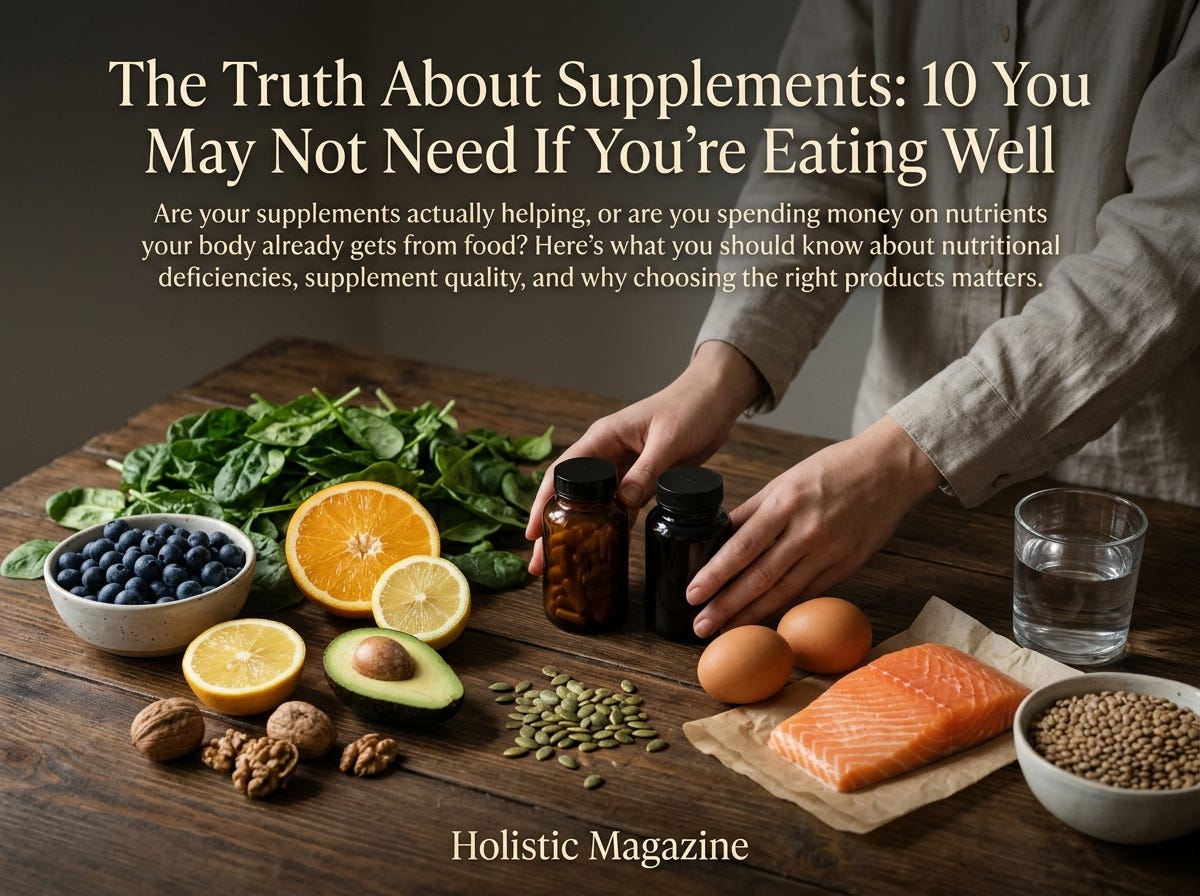
Are your supplements actually helping, or are you spending money on nutrients your body already gets from food? Here’s what you should know about nutritional deficiencies, supplement quality, and why choosing the right products matters.
Hi friends,
Let me ask you something.
How many supplements are sitting in your kitchen cabinet right now?
Maybe you take a multivitamin every morning. Perhaps you’ve added magnesium to help with sleep, vitamin D for immune health, omega-3s for your heart, or a B-complex because you’ve heard it can improve energy.
And if you’re like many health-conscious people, your collection has probably grown over the years.
One supplement for your bones.
Another for your brain.
Something for inflammation.
And maybe a few more because someone on social media said they were essential.
But here’s something worth thinking about.

How do you know whether your body actually needs all those supplements?
And perhaps an even more important question:
How do you know whether the supplements you’re buying are actually good quality?
The supplement industry has become enormous, with thousands of products promising everything from better energy and stronger immunity to improved digestion and healthier aging.
Some supplements can be genuinely beneficial.
Certain nutrients are essential for people with diagnosed deficiencies, specific dietary restrictions, absorption problems, or increased nutritional needs.
But others may provide little additional benefit when you’re already getting enough of those nutrients through your diet.
And there’s another issue we don’t talk about nearly enough.
Not all supplements are created equal.
Two products can contain the same advertised ingredient, yet differ in their manufacturing practices, purity, formulation, dose, and independent quality verification.
At Holistic Magazine, we believe nutrition should start with real food whenever possible.
But we also recognize something important.
Many people aren’t getting all the nutrients they need from their diets.
Even people who make an effort to eat well can develop deficiencies because of age, medications, digestive conditions, dietary restrictions, or other individual factors.
That’s why the conversation around supplements deserves more nuance than simply telling everyone to take them or avoid them.
Our team has tested and evaluated more than 50 supplement brands, and through that process, we’ve developed conclusions about which products we feel confident recommending.
We’ll share more about that later.
First, let’s explore what your body may already be getting from food, when supplementation may be worthwhile, and why taking more doesn’t always mean better health.
In Less Than 10 Minutes, We’ll Cover:
Why whole foods should generally be your nutritional foundation
10 common supplements you may not need if your diet already provides enough
Why nutritional deficiencies can still occur in people who eat well
The surprising differences in supplement quality
Why expensive supplements aren’t necessarily better
How taking too much of certain vitamins and minerals can be harmful
What we’ve learned from evaluating more than 50 supplement brands
How to get personalized guidance on choosing supplements
Before we begin, if you’re unsure which supplements are actually worth taking, we invite you to schedule a FREE consultation with our team.
We can discuss your nutrition, lifestyle, and supplement questions, explain the types of products we recommend, and help you consider whether additional evaluation may be appropriate.
Schedule your FREE consultation to learn more about our supplement recommendations.
First, Why Is Getting Nutrients From Food So Important?

Let’s start with something fundamental.
Your body was designed to obtain nutrients from the food you eat.
A serving of spinach, for example, doesn’t contain just one vitamin.
It provides vitamin K, folate, carotenoids, magnesium, fiber, and numerous naturally occurring plant compounds.
A handful of walnuts provides healthy fats, protein, fiber, minerals, and polyphenols.
An orange provides vitamin C alongside water, fiber, and other beneficial compounds.
And here’s what makes whole foods particularly interesting.
The nutritional value of food goes beyond the individual vitamins and minerals listed on a supplement bottle.
Foods contain combinations of nutrients and other compounds that work together as part of a healthy dietary pattern.
For example, the fiber in beans can support digestion, blood sugar regulation, and cholesterol management.
You won’t get those same benefits simply by swallowing a vitamin tablet.
Similarly, fatty fish provides omega-3 fatty acids along with protein, vitamin B12, selenium, and other nutrients.
That’s one reason nutrition experts generally recommend obtaining essential nutrients from a balanced, varied diet whenever practical.
But there’s an important distinction.
Food should be the foundation of good nutrition.
That doesn’t mean food alone is always enough for everyone.
Some people have increased nutrient requirements.
Others have difficulty absorbing certain vitamins and minerals.
And some simply don’t consume enough nutrient-rich foods consistently.
Supplements can help fill those gaps when they’re appropriately selected.
The challenge is knowing which gaps actually exist.
10 Supplements You May Not Need If You’re Eating Well

1. Multivitamins: Do You Really Need a Little Bit of Everything?
Let’s start with one of the most popular supplements in the world.
The daily multivitamin.
For many people, taking a multivitamin feels like an insurance policy.
Even if you don’t eat perfectly, you’re getting a little extra nutritional protection.
But here’s something worth understanding.
If your diet consistently includes vegetables, fruits, whole grains, protein-rich foods, nuts, seeds, and other nutrient-dense options, you may already be meeting many of your nutritional needs.

And research hasn’t consistently shown that taking a standard daily multivitamin prevents major chronic diseases in otherwise well-nourished adults.
That doesn’t mean multivitamins are useless.
They can be helpful for people with limited dietary variety, certain nutritional gaps, or specific medical needs.
Pregnancy is another important exception, when appropriately formulated prenatal supplements are often recommended.
What you can do:
Take a closer look at what you’re eating before assuming you need a supplement containing dozens of ingredients.
If your diet is consistently limited or you have concerns about nutrient deficiencies, discuss whether a multivitamin or more targeted supplement would be appropriate.
Sometimes a specific nutrient is more useful than taking a little bit of everything.
2. Vitamin C: More Doesn’t Always Mean Stronger Immunity
Vitamin C has become almost synonymous with immune health.
Walk into any supplement store and you’ll find products containing 500, 1,000, or even more milligrams per serving.
But how much vitamin C do you actually need?
For most adults, the recommended daily intake is 75 milligrams for women and 90 milligrams for men, with additional requirements for people who smoke.
And here’s something surprising.
A single medium orange can provide much of an adult’s daily vitamin C requirement.
Bell peppers, strawberries, kiwifruit, broccoli, and citrus fruits are also excellent sources.

While vitamin C supports normal immune function, taking very large amounts doesn’t necessarily mean your immune system will work better.
Excessive supplemental vitamin C may also cause diarrhea, nausea, or abdominal discomfort.
What you can do:
Include vitamin C-rich fruits and vegetables regularly.
If you’re eating these foods consistently, you may not need a separate high-dose vitamin C supplement.
However, people with very limited diets, certain absorption conditions, or increased requirements may benefit from additional vitamin C.
3. B-Complex Vitamins: Are You Taking Them for Energy?
This is something we hear frequently.
“I’m always tired, so I started taking B vitamins.”
And it’s understandable.
B vitamins play important roles in helping your body convert food into usable energy.
They also support nervous system function, red blood cell production, and numerous metabolic processes.
But there’s a common misunderstanding.
B vitamins don’t automatically give you more energy simply because you take more of them.
If you’re already getting adequate amounts, adding extra B vitamins generally won’t produce the same effect as correcting a true deficiency.
Foods such as eggs, fish, meat, legumes, leafy greens, whole grains, and dairy products provide different B vitamins.

And while supplementation can be important for people with deficiencies or certain dietary restrictions, high-dose formulas deserve caution.
For example, excessive vitamin B6 intake over time can cause nerve damage.
What you can do:
Before purchasing another energy-focused B-complex supplement, consider whether your fatigue may have another explanation.
Inadequate sleep, stress, iron deficiency, thyroid conditions, and other health concerns can all contribute to persistent tiredness.
The best approach is understanding what’s actually causing your symptoms.
4. Vitamin B12: Essential, but Not Everyone Needs Extra
Vitamin B12 deserves special attention.
Your body needs it to produce healthy red blood cells, maintain normal nerve function, and support DNA synthesis.
Without enough B12, you may develop fatigue, weakness, numbness, tingling, or cognitive changes.
But here’s where things become interesting.
If you regularly eat fish, meat, eggs, dairy products, or B12-fortified foods, you may already obtain enough from your diet.

However, some people struggle to absorb B12 even when they eat foods containing it.
Older adults, individuals with certain digestive disorders, people taking metformin or some acid-reducing medications, and those following vegan diets can face increased risks.
And because untreated B12 deficiency can lead to serious neurological complications, it shouldn’t be ignored.
What you can do:
If you follow a vegan diet, ensure you have a reliable source of B12 through fortified foods or supplements.
If you’re older, take certain medications, or experience unexplained fatigue or tingling, ask your healthcare professional whether B12 testing is appropriate.
For some people, B12 supplementation is unnecessary.
For others, it’s essential.
5. Iron: A Supplement You Shouldn’t Take Just Because You’re Tired
Iron is one of the most important minerals in the human body.
It helps your red blood cells transport oxygen throughout your body.
When iron levels become too low, you may experience fatigue, weakness, dizziness, or shortness of breath.
But here’s something important.
Taking iron when you don’t need it can create problems.
Excess iron can be harmful, and iron supplements commonly cause constipation, nausea, and digestive discomfort.
Fortunately, many foods provide iron naturally.
Red meat, seafood, beans, lentils, tofu, and fortified grains are all sources.
Plant-based iron is generally absorbed less efficiently than iron from animal foods, but combining it with vitamin C-rich foods can improve absorption.
For example, lentils paired with bell peppers or tomatoes can make a nutritious combination.

What you can do:
If you’re concerned about low iron, consider discussing appropriate blood testing with your healthcare professional.
Women with heavy menstrual bleeding, pregnant individuals, frequent blood donors, and people with certain digestive conditions may have increased iron needs.
Don’t automatically reach for an iron supplement just because you’re feeling exhausted.
Find out whether iron deficiency is actually involved.
6. Calcium: Sometimes Your Diet Is Already Providing Enough
Calcium is essential for maintaining strong bones, supporting muscle contraction, and enabling normal nerve function.
And as we age, protecting bone health becomes increasingly important.
That’s why calcium supplements are so widely marketed, particularly to older adults.
But here’s something worth considering.
You may already be getting a meaningful amount of calcium through food.
Yogurt, milk, cheese, calcium-fortified plant milks, calcium-set tofu, and canned sardines with bones can all provide substantial amounts.
Certain leafy vegetables also contribute calcium.

For people whose diets consistently provide adequate calcium, adding a supplement may offer little additional benefit.
Excessive supplemental calcium can increase the risk of kidney stones in some people.
What you can do:
Estimate how much calcium you’re getting from your regular diet.
Your requirements depend partly on age and other factors.
If you aren’t meeting your needs through food, supplementation may be appropriate.
The goal is to reach an adequate intake, not consume as much calcium as possible.
7. Magnesium: Popular for Sleep, Stress, and Everything Else
Magnesium has become one of the most talked-about minerals in wellness.
It’s promoted for sleep, relaxation, muscle recovery, energy, and stress.
And magnesium really is important.
It participates in hundreds of enzymatic reactions throughout your body and contributes to normal nerve function, muscle function, and energy metabolism.
But here’s something that often gets overlooked.
Magnesium is found in many everyday foods.
Pumpkin seeds, almonds, cashews, beans, spinach, and whole grains are all useful sources.

If you’re regularly eating these foods and meeting your magnesium requirements, you may not benefit from additional supplementation.
However, magnesium intake is inadequate for many people, and certain digestive conditions, medications, and health concerns can increase the risk of deficiency.
There’s also a difference between various magnesium formulations.
Some are absorbed differently or have different gastrointestinal effects.
And taking too much supplemental magnesium can cause diarrhea and other problems.
What you can do:
Evaluate your dietary intake before choosing a magnesium supplement.
If supplementation makes sense, pay attention to the dose, formulation, and potential medication interactions.
More magnesium doesn’t automatically mean better sleep or better health.
8. Zinc: Important for Immunity, but Too Much Can Backfire
Zinc supports normal immune function, wound healing, DNA synthesis, and many other biological processes.
You’ll frequently see zinc supplements marketed for immune defense.
And zinc deficiency can impair immune function.
But that doesn’t mean everyone benefits from taking extra zinc every day.
Oysters, beef, poultry, beans, seeds, nuts, and dairy products are all dietary sources.

If your diet already provides adequate zinc, long-term high-dose supplementation may be unnecessary.
And here’s something especially important.
Excessive zinc intake can interfere with copper absorption.
Over time, this may contribute to copper deficiency, anemia, and neurological problems.
It’s a good example of why nutrients need to be consumed in appropriate amounts.
What you can do:
Focus on obtaining zinc through a varied diet.
If you’re considering long-term supplementation, review your overall zinc intake, especially if you’re already taking a multivitamin or immune-support formula.
Several supplements containing the same nutrient can add up quickly.
9. Omega-3 Supplements: Could Eating Fish Be Enough?
Omega-3 fatty acids play important roles in cell membranes, cardiovascular health, and normal bodily function.
And there’s substantial interest in their potential health benefits.
That’s why fish oil capsules have become so popular.
But here’s something many people forget.
Fatty fish already contains the omega-3s EPA and DHA.
Salmon, sardines, trout, herring, and mackerel are particularly good sources.

For many adults, eating fatty fish about twice a week is a practical way to obtain these nutrients.
And unlike a fish oil capsule, fish also provides protein, vitamin B12, selenium, and other beneficial nutrients.
However, omega-3 supplements can still be useful in certain circumstances.
For example, prescription omega-3 products may be recommended for people with very high triglyceride levels.
People who don’t eat fish may also consider algae-derived omega-3 supplements depending on their dietary needs.
What you can do:
If you regularly eat fatty fish, you may not need an additional fish oil supplement.
If you avoid seafood or have a specific medical reason for supplementation, discuss your options with a qualified professional.
And remember, fish oil products vary in concentration, freshness, and quality.
10. Vitamin E: More Antioxidants Aren’t Always Better
Vitamin E is an antioxidant that helps protect cells from oxidative damage.
It also supports immune function and other important processes.
But here’s something worth knowing.
Vitamin E deficiency is uncommon in otherwise healthy people.
Almonds, sunflower seeds, vegetable oils, and other foods can provide vitamin E.

And while antioxidants are important for health, taking large doses of supplemental antioxidants doesn’t automatically improve health outcomes.
In fact, high-dose vitamin E supplementation may increase bleeding risk, particularly in people taking certain medications.
Some large clinical trials have also raised concerns about potential harms from particular high-dose vitamin E regimens.
What you can do:
Include foods such as almonds, sunflower seeds, and other vitamin E sources in your diet.
Unless you have a specific medical indication, high-dose vitamin E supplementation is generally unnecessary.
Your body needs adequate amounts of antioxidants.
It doesn’t necessarily benefit from megadoses.
But Here’s the Other Side: Many People Still Have Nutritional Gaps

Now that we’ve discussed supplements you might not need, let’s address something equally important.
Just because nutrients are available in food doesn’t mean everyone is getting enough of them.
In an ideal world, everyone would eat a balanced diet containing a wide variety of nutrient-rich foods every single day.
But that’s not always realistic.
People have busy schedules.
Food preferences differ.
Some individuals avoid entire food groups.
Others live with digestive conditions that interfere with nutrient absorption.
And as we grow older, our bodies may become less efficient at absorbing certain nutrients.
For example:
Vitamin D: Many people don’t obtain enough through food alone. Sun exposure, age, skin pigmentation, geography, and other factors can influence vitamin D status.
Vitamin B12: Older adults and individuals with certain absorption problems may need supplementation even when their diets contain B12.
Iron: People with heavy menstrual bleeding, pregnancy-related needs, or gastrointestinal blood loss may develop deficiencies.
Calcium: People who avoid dairy and don’t regularly consume other calcium-rich foods may struggle to meet their requirements.
Magnesium: Dietary surveys suggest many Americans consume less magnesium than recommended.
Potassium: Many adults fall short of recommended potassium intake, although potassium supplements are not automatically appropriate and can be dangerous for some people.
And here’s something important.
A nutrient deficiency isn’t always obvious.
You may notice fatigue, muscle weakness, changes in concentration, or other symptoms.
But many symptoms overlap with other health conditions, and some deficiencies develop without obvious warning signs.
That’s why understanding your individual needs matters.
The goal shouldn’t be taking as many supplements as possible. It should be identifying which nutrients you actually need.
Sometimes improving your diet is enough.
Sometimes supplementation makes sense.
And sometimes additional medical evaluation is the most appropriate next step.
The Supplement Quality Problem: Are You Actually Getting What You Pay For?

This is where the conversation becomes particularly interesting.
Imagine walking into a supplement store and finding five different bottles of magnesium.
They all advertise magnesium on the front.
One costs $12.
Another costs $25.
Another costs $45.
And one costs nearly $70.
How do you know which one is worth buying?
It’s tempting to assume the most expensive option must be the best.
But that’s not necessarily true.
Price, packaging, and popularity don’t guarantee quality.
In the United States, dietary supplements are regulated differently from prescription medications.
Manufacturers are responsible for ensuring their products meet applicable safety and quality requirements, but most dietary supplements do not require FDA approval before being sold.
And that distinction matters.
A supplement label may tell you what the manufacturer claims is inside the bottle.
But it doesn’t necessarily tell you everything about the quality of the finished product.
Here are several things worth paying attention to.
1. Does the Product Actually Contain What the Label Claims?
One of the most basic questions is whether the supplement contains the advertised ingredient at the stated amount.
Independent testing can help verify ingredient identity and potency.
Without reliable quality verification, consumers may have difficulty assessing whether a particular product meets its label claims.
2. Has It Been Tested for Contaminants?
Depending on the ingredient and manufacturing process, supplements may face contamination risks involving heavy metals, microorganisms, or other unwanted substances.
This is particularly relevant for certain botanical products and ingredients sourced from environments where contaminants may be present.
Responsible manufacturers use appropriate testing and quality controls to reduce these risks.
3. Is the Dose Appropriate?
A higher dose isn’t automatically better.
Some supplement manufacturers emphasize large amounts of vitamins or minerals because high numbers look impressive on the label.
But the body has limits.
Fat-soluble vitamins such as vitamins A, D, E, and K can accumulate under certain circumstances.
Excessive intake of minerals such as iron, zinc, and selenium can also be harmful.
The right dose depends on the nutrient and your individual needs.
4. Does the Formulation Make Sense?
Not every form of a nutrient has identical properties.
Different formulations can vary in absorption, tolerability, and intended use.
For example, magnesium citrate and magnesium oxide have different characteristics.
But a more expensive or heavily marketed form isn’t automatically superior for everyone.
The formulation needs to make sense for the intended purpose.
5. Is There Credible Independent Quality Verification?
One thing we encourage people to look for is independent third-party certification or testing.
Programs such as USP Verified and NSF certification can provide additional assurance about specific quality standards.
However, these certifications don’t necessarily prove that a supplement will improve your health or treat a particular condition.
They help address product quality.
Clinical effectiveness is a separate question.
And that’s a distinction worth remembering.
A supplement can be manufactured to high standards and still be unnecessary for your body.
We’ve Evaluated More Than 50 Supplement Brands. Here’s Why That Matters.

At Holistic Magazine, we’ve spent considerable time exploring the supplement marketplace.
Our team has tested and evaluated more than 50 supplement brands.
And through that process, we’ve reached conclusions about which products we feel confident recommending.
Why did we invest time in this?
Because we believe people deserve better guidance than simply choosing whichever supplement has the most attractive packaging, the biggest marketing budget, or the strongest claims.
The supplement market can be confusing.
You’ll find products promoted by influencers, companies making sweeping promises, and countless formulas advertised as revolutionary.
Some products may be useful.
Others may be unnecessary.
And some deserve additional scrutiny regarding their formulation, manufacturing standards, or supporting evidence.
One of the biggest lessons is that choosing a supplement requires looking beyond the front of the bottle.
We want to understand what’s in a product, whether the formulation is appropriate, how quality is assessed, and whether there’s credible evidence supporting its intended use.
We also recognize that the products suitable for one person may not be appropriate for someone else.
A person with low vitamin D may have very different nutritional needs from someone with iron deficiency.
An older adult may have different needs from a younger, otherwise healthy individual.
And someone taking several medications needs to consider interactions that another person may not face.
That’s why we believe supplement recommendations should start with the individual.
Not with a shopping list.
And not with the assumption that everyone needs the same collection of pills.
Our evaluations have helped us narrow down the brands and products we’re most comfortable discussing and recommending, based on the information available to us.
But it’s important to distinguish product-quality assessments from clinical proof. Our brand evaluations do not, by themselves, establish that a product will produce a particular health benefit.
And that’s exactly why personalized guidance matters.
7 Things to Do Before Buying Another Supplement

If you’ve made it this far, you may be wondering what to do with the supplements already sitting in your cabinet.
Here are seven practical steps worth considering.
1. Start with your food.
Look at what you’re consistently eating throughout the week. A balanced diet can provide many of the vitamins and minerals your body needs without additional supplementation.
2. Identify your actual nutritional gaps.
Consider your dietary restrictions, age, medications, health history, and other factors that could affect nutrient intake or absorption.
3. Don’t diagnose deficiencies based on symptoms alone.
Fatigue, headaches, and muscle weakness can have many explanations. When appropriate, laboratory testing and professional evaluation can help clarify whether a deficiency exists.
4. Read the entire supplement label.
Pay attention to the ingredients, nutrient amounts, serving sizes, and warnings. Look for nutrients that may already be present in other supplements you’re taking.
5. Look for credible quality verification.
Favor manufacturers that provide meaningful information about quality controls, ingredient testing, and independent certification where available.
6. Be skeptical of extraordinary promises.
Supplements advertised as curing chronic diseases, reversing aging, or producing dramatic results deserve careful scrutiny.
7. Review your supplements with a qualified professional.
This is especially important if you’re pregnant, managing a medical condition, taking prescription medications, or considering high doses.
And here’s something else.
You don’t necessarily need to throw away everything in your supplement cabinet.
Some products may be appropriate for your needs.
Others may be unnecessary.
The goal is to make more informed decisions rather than following every new wellness trend.
Bringing It Together: Better Nutrition Starts With Understanding What Your Body Needs

Here’s what we hope you’ll remember from today’s newsletter.
Your body needs vitamins, minerals, protein, healthy fats, fiber, and numerous other nutrients to function properly.
And whenever possible, obtaining those nutrients from a varied, nutritious diet is an excellent place to start.
But we also live in a world where nutritional gaps are common.
Some people don’t eat enough nutrient-rich foods.
Others have increased requirements or difficulty absorbing certain nutrients.
And certain deficiencies can develop even when someone believes they’re eating well.
That’s why supplements can be valuable.
The question isn’t whether supplements are good or bad. It’s whether they’re necessary, appropriate, and of reliable quality for the person taking them.
A high-quality vitamin B12 supplement may be essential for someone who cannot absorb enough B12.
An iron supplement may be important for someone with confirmed iron deficiency.
Vitamin D supplementation may be appropriate for someone at increased risk of inadequate vitamin D status.
But taking large doses of nutrients your body already has enough of may provide no meaningful benefit.
And in some cases, it can cause harm.
Then there’s the question of quality.
Not every brand uses the same ingredients, formulations, manufacturing practices, or testing procedures.
And as consumers, we deserve to know more about what we’re putting into our bodies.
That’s why our team at Holistic Magazine has invested time in evaluating more than 50 supplement brands.
We’ve developed recommendations based on that work, and we want to help you make more informed choices.
Because ultimately, good health shouldn’t require a cabinet overflowing with expensive products.
Sometimes it’s about eating better.
Sometimes it’s about addressing a specific deficiency.
And sometimes it’s about choosing a carefully evaluated supplement that meets a genuine need.
The most important thing is understanding the difference.
Want to Know Which Supplements We Recommend?
If you’ve ever wondered whether your supplements are worth taking, whether you’re missing important nutrients, or which brands deserve your trust, we’d love to help.
At Holistic Magazine, our team has evaluated more than 50 supplement brands and developed recommendations to help people navigate an often-confusing marketplace.
We invite you to schedule a FREE consultation to learn more about the products we recommend and discuss your individual nutrition and wellness goals.
During your consultation, you can:
Learn more about the supplement brands and products we recommend.
Discuss your current supplements and nutritional habits.
Explore whether your diet may be leaving important nutritional gaps.
Ask questions about supplement quality, formulation, and appropriate use.
Discuss whether additional evaluation by a qualified healthcare professional may be helpful.
There’s no need to keep guessing about which supplements belong in your daily routine.
Schedule your FREE consultation today and learn more about our recommendations.
Here’s to making smarter choices, nourishing your body with real food, and investing in the nutrients that genuinely matter to your health.